
Setting up or upgrading an office requires significant investment, especially when it comes to interiors, furniture, and workspace design. For many businesses, managing this cost becomes a major challenge because it directly impacts cash flow and operational stability. This is why most companies look for financial support options before starting an office fitout project.
Two of the most common financing options are fitout finance and business loans. While both help businesses manage expenses, they work in very different ways. Many business owners often get confused about which option is better for office interiors, especially when they want to balance quality, cost, and long-term financial health.
Choosing the wrong financing method can lead to unnecessary financial pressure, higher interest costs, or restricted flexibility in project execution. On the other hand, the right choice can help businesses build a modern, productive, and well-designed workspace without blocking their working capital.
Today, office design is not just about aesthetics; it plays a key role in productivity, brand image, and employee satisfaction. That is why smart financial planning is essential, especially when combined with professional Commercial Interior Design solutions.
In this blog, we will compare fitout finance and business loans in detail to help you understand which option is more suitable for office interiors and long-term business growth.
What is Fitout Finance?
Fitout finance is a specialized funding solution designed specifically for office interior projects, helping businesses set up or upgrade their workspace without paying the full cost upfront. Instead of making a large one-time investment, companies can spread the total cost over a fixed repayment period through manageable monthly or quarterly installments.
This financing option is purpose-built for interior design and construction work. It typically covers expenses such as office layout planning, furniture, lighting systems, partitions, flooring, electrical work, and complete workspace execution. This allows businesses to create fully functional and modern offices while maintaining healthy cash flow.
Unlike general loans, fitout finance is directly linked to the interior project. The funds are usually disbursed in coordination with interior design companies, ensuring that the money is used only for workspace development. This structured approach reduces financial misuse and keeps the project aligned with execution timelines.
One of the biggest advantages of fitout finance is its simplicity and focus. It is designed to support business growth by removing upfront financial pressure, especially for startups and expanding companies. Instead of blocking capital in infrastructure, businesses can invest in operations, hiring, and marketing.
When combined with professional Commercial Interior Design, fitout finance enables companies to build efficient, scalable, and visually appealing office environments while maintaining financial stability and supporting long-term growth strategies.
What is a Business Loan?
A business loan is a traditional financing option provided by banks and financial institutions to support various business needs. Unlike fitout finance, a business loan is not limited to a specific purpose. It can be used for office setup, expansion, working capital, equipment purchase, or even daily operational expenses depending on the business requirement.
In a business loan, the borrower receives a lump sum amount and repays it over a fixed tenure along with interest. The repayment is usually done in monthly installments, which include both principal and interest. The interest rate depends on factors such as credit score, business history, income stability, and lender policies.
One of the key features of a business loan is flexibility. Since the funds are not restricted to a specific use, businesses can allocate them as needed. However, this flexibility can also become a drawback when the loan is used for office interiors, as it may lead to mismanagement of funds or higher financial burden.
Approval for business loans often requires extensive documentation, credit checks, and financial history verification. For startups or new businesses, getting approval can sometimes be difficult compared to established companies.
While business loans can support office interior projects, they are not specifically designed for them. This is why many companies now compare them with fitout finance, especially when planning projects related to Commercial Interior Design, where cost control, structured payments, and project-specific funding are more important for smooth execution and financial stability.
Key Differences Between Fitout Finance and Business Loans
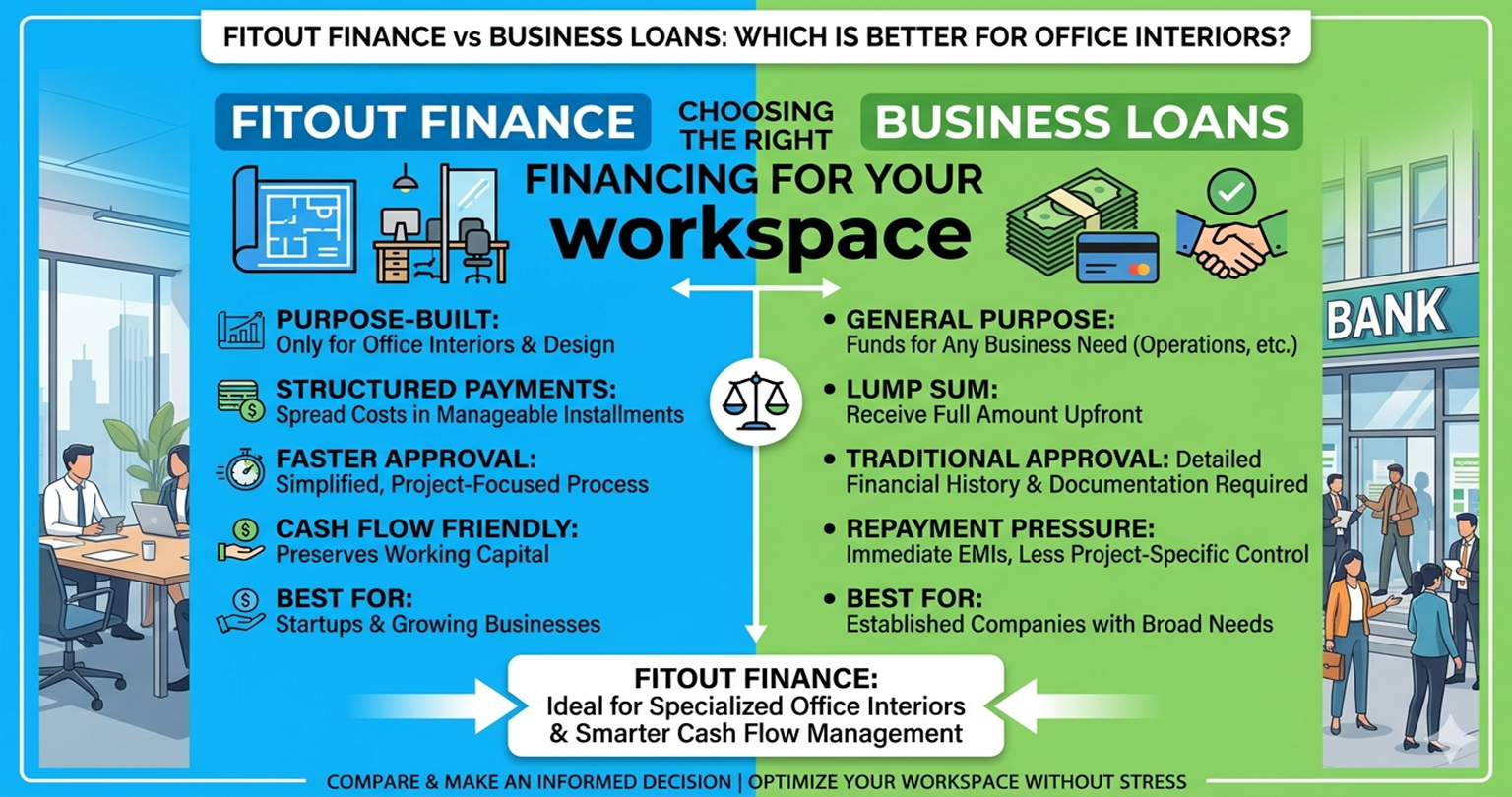
Fitout finance and business loans are often compared because both help businesses manage funding needs, but their purpose and structure are very different. Understanding these differences is important for companies planning office interiors and trying to manage cash flow efficiently.
Purpose and Usage
Fitout finance is specifically designed for office interiors and workspace development. It is purpose-built to cover design, furniture, and execution costs in a structured way. Business loans, on the other hand, are general-purpose funds that can be used for any business requirement, including operations, expansion, or interiors. This makes fitout finance more focused and relevant for Commercial Interior Design projects.
Approval Process
Fitout finance usually involves a simpler and faster approval process because it is linked directly with interior projects and approved vendors. The evaluation is more project-based rather than heavily dependent on long financial history. Business loans require detailed documentation, credit scores, income proof, and financial statements, which can make the approval process longer and more strict, especially for startups.
Fund Utilization
In fitout finance, funds are directly allocated to the interior project, ensuring controlled usage and reducing the risk of misallocation. Payments are often released in stages aligned with project progress. Business loans provide a lump sum amount, giving flexibility but also increasing the risk of funds being diverted to non-essential expenses.
Cash Flow and Repayment Structure
Fitout finance is designed to support cash flow by offering structured and predictable installment plans. This helps businesses avoid financial pressure during office setup.
Financial Risk and Flexibility
Fitout finance reduces financial risk by aligning payments with project execution. It allows businesses to focus on growth without worrying about upfront costs. Business loans offer flexibility in usage but come with higher repayment pressure and less project-specific control.
Overall, when it comes to office interiors and Commercial Interior Design, fitout finance is more structured, efficient, and business-friendly compared to traditional business loans.
Cost Comparison: Which is More Affordable?
When comparing fitout finance and business loans, cost is one of the most important factors that businesses need to evaluate. While both options provide financial support, their overall cost structure and impact on long-term finances can be quite different.
In a business loan, the total cost usually includes interest rates, processing fees, documentation charges, and sometimes hidden costs depending on the lender. Interest rates may vary based on credit score, financial history, and market conditions. Over time, these charges can significantly increase the total repayment amount, making business loans relatively expensive for office interior projects.
Fitout finance, on the other hand, is designed specifically for interior projects, so its cost structure is more aligned with project execution. The repayment is usually structured in fixed installments that match the project value and timeline. This helps businesses avoid unexpected financial burden and makes budgeting more predictable.
Another key difference is how cost affects cash flow. With business loans, EMI obligations start immediately and continue regardless of project progress. This can create pressure on monthly finances. Fitout finance spreads the cost in a more balanced way, allowing businesses to manage expenses without blocking operational funds.
Which Option is Better for Office Interiors?
When it comes to choosing between fitout finance and business loans for office interiors, the better option largely depends on the specific needs, financial condition, and growth stage of a business. However, for most companies focused on workspace development, fitout finance is often the more suitable and practical choice.
Fitout finance is specifically designed for interior projects, which makes it highly relevant for office setup needs. It ensures that funds are directly used for design, furniture, and execution without unnecessary diversion. This helps businesses maintain better control over project costs and avoid financial mismanagement. For startups and growing companies, this focused structure is extremely beneficial.
Business loans, although flexible, are not tailored for interiors. They can be used for multiple purposes, but this flexibility can also become a disadvantage when funds are not properly allocated. Additionally, the higher EMI burden and interest costs can create pressure on monthly cash flow, especially during early business stages.
Fitout finance also supports smoother project execution because payments are often linked with project milestones. This ensures that interior work progresses without financial delays, resulting in faster office setup and better coordination between designers and contractors.
From a practical standpoint, businesses that want to prioritize Commercial Interior Design quality without compromising cash flow will find fitout finance more effective. It allows them to invest in better materials, modern layouts, and scalable workspace solutions while maintaining financial stability.
Overall, fitout finance is generally the better option for office interiors because it is purpose-built, cost-efficient, and aligned with project needs, whereas business loans are better suited for general business financing rather than specialized workspace development.
How Fitout Finance Supports Commercial Interior Design Projects
Fitout finance plays a crucial role in enhancing the quality and execution of Commercial Interior Design projects by removing financial barriers that often limit creativity and planning. When businesses are not under pressure to arrange large upfront capital, they can focus on building more efficient, modern, and productive office environments.
One of the biggest advantages is design freedom. With fitout finance, companies are not forced to cut corners due to budget limitations. They can invest in better materials, ergonomic furniture, advanced lighting systems, and smart workspace layouts that improve employee comfort and productivity. This results in a more functional and visually appealing office space.
Another important benefit is smoother project execution. Since payments are structured and aligned with project milestones, interior designers and contractors can work without financial interruptions. This ensures timely completion of office fitouts and reduces the risk of delays.
Fitout finance also allows businesses to think long-term. Instead of focusing only on immediate cost, companies can invest in scalable office designs that can grow with their business. This flexibility is especially important for startups and expanding organizations.
Common Mistakes Businesses Make When Choosing Finance
One of the most common mistakes businesses make is choosing a financing option without fully understanding their project requirements. Many companies select a business loan simply because it is widely available, without realizing that it may not be suitable for office interior projects. This often leads to higher financial pressure and inefficient cash flow management.
Another mistake is ignoring the long-term cost impact. Businesses sometimes focus only on immediate approval or quick funding, without calculating total repayment, interest rates, and additional charges. This can make office setup more expensive than expected and reduce financial flexibility in the long run.
Poor planning is another major issue. Some businesses fail to align their financing decision with their actual project timeline. This results in delays, unfinished interiors, or unnecessary financial strain during execution. Without proper structure, even good funding options can become ineffective.
Many companies also overlook the importance of project-specific financing like fitout finance. Instead of choosing a solution designed for office interiors, they opt for general-purpose loans that do not support structured execution.
When combined with professional Commercial Interior Design, the right financial choice ensures smooth project delivery, better cost control, and higher workspace quality. Avoiding these mistakes helps businesses build efficient offices while maintaining financial stability and supporting long-term growth.
Who Should Choose What?
Choosing between fitout finance and business loans depends largely on the size, stage, and financial goals of a business. Both options have their advantages, but they serve different types of requirements when it comes to office interiors and overall business financing.
Startups and early-stage companies are generally better suited for fitout finance. Since they operate with limited capital and need to maintain strong cash flow, a structured, project-specific solution helps them build offices without financial stress. Fitout finance allows them to create modern workspaces while keeping funds available for operations, hiring, and marketing.
Small and medium-sized enterprises (SMEs) can also benefit more from fitout finance, especially when upgrading or expanding their office spaces. It offers better control over expenses and ensures that growth is not slowed down by large upfront investments.
Large corporations, on the other hand, may choose business loans depending on their internal financial strategy. Since they often have stronger cash reserves, they may prefer flexible funding options for multiple business needs beyond interiors.
However, for any business focused specifically on office setup or renovation, fitout finance is usually the more practical choice. It is purpose-built for interior projects and works more efficiently with Commercial Interior Design requirements, ensuring smoother execution, better cost management, and improved workspace quality without putting unnecessary pressure on cash flow.
Role of Interior Companies in Financing Decisions
Interior companies play a very important role in helping businesses choose the right financing option for office interiors. Their expertise goes beyond design and execution—they also guide clients on how to manage budgets effectively and select the most suitable funding structure for their project.
In many cases, experienced interior firms work closely with finance providers to offer integrated solutions like fitout finance. This collaboration helps businesses streamline both design and funding under one structured process. It reduces confusion, speeds up approvals, and ensures smoother project execution without financial delays.
Interior companies also help businesses create realistic budget plans based on actual project requirements. They assess space size, design complexity, material selection, and execution timelines to estimate accurate costs. This helps clients avoid over-borrowing or under-budgeting, both of which can negatively impact project outcomes.
Another important role is ensuring that financing aligns with project milestones. Interior firms coordinate work progress with payment schedules so that construction and design work continue without interruption.
Experienced companies specializing in Commercial Interior Design also help businesses choose cost-effective yet high-quality solutions. They balance aesthetics, functionality, and financial feasibility to deliver the best possible workspace within the available budget.
Conclusion
Choosing between fitout finance and business loans is an important decision for any business planning an office interior project. While both options provide financial support, their suitability depends on how well they align with project-specific needs, cash flow requirements, and long-term business goals.
Business loans offer flexibility and can be used for multiple purposes, but they often come with higher financial pressure and less control over how funds are used. On the other hand, fitout finance is specifically designed for office interiors, making it a more structured and efficient solution for workspace development.
For startups and growing businesses, maintaining cash flow while building a functional and modern office is critical. Fitout finance helps achieve this balance by spreading costs over time and ensuring smoother project execution without financial strain.
When combined with professional Commercial Interior Design, the right financing option enables businesses to create high-quality, scalable, and productive office environments. This not only improves employee performance but also strengthens brand image and operational efficiency.
Ultimately, the best choice depends on the nature of the business, but for most office interior projects, fitout finance proves to be the more practical, cost-effective, and business-friendly solution for sustainable growth.